Run MemoryPlugin as a local MCP process so any MCP client can read and write your memory
The Model Context Protocol (MCP) lets AI clients call external tools. MemoryPlugin ships an MCP server, so any MCP client can store and recall your memory and chat history through it. This page covers the local server, which runs on your machine via Node.js.
Most people should use the hosted Remote MCP server instead. It needs no Node.js and no token in a config file: you connect by URL and approve access in your browser. Use this local server only when you specifically want a process on your own machine, for example to keep the connection fully under your control or when your client cannot do the browser sign-in flow. The tools and data are the same either way.
An MCP client such as Claude Desktop, Cursor, or Windsurf.
A MemoryPlugin account to get your auth token.
Local MCP setup is more technical than the other integrations. You edit a JSON config file by hand and paste in a token. If that is not what you want, the Remote MCP server is the easier path.
You do not install the server like an app. You add a config entry to your MCP client that tells it to run the MemoryPlugin server on demand.
1
Copy your auth token
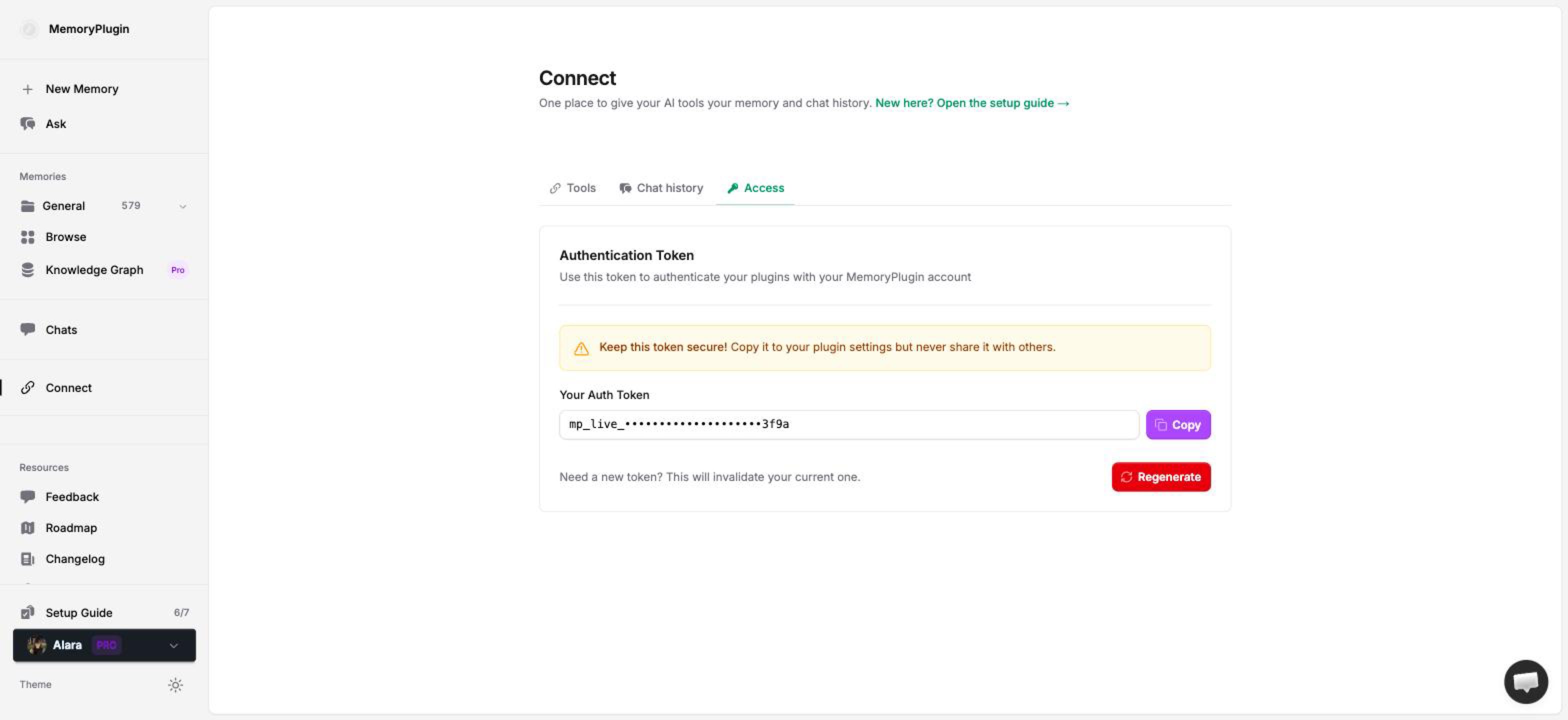
In the MemoryPlugin dashboard, click Connect in the sidebar and open the Access tab. Under Authentication Token, click Copy to copy Your Auth Token. Direct link: memoryplugin.com/dashboard/connect?tab=access.
Connect → Access: copy Your Auth Token, or regenerate it if it ever leaks.
This token is like a password to your account. Paste it into your config, but never share it. If it leaks, click Regenerate on the same screen to invalidate the old one.
2
Add the server to your client config
Add the MemoryPlugin entry to your client’s MCP config file (see the example below) and paste your token in as MEMORY_PLUGIN_TOKEN.
3
Restart and use it
Restart your client so it picks up the new server. The AI then calls the MemoryPlugin tools when they are relevant.
Account email independence: Your MemoryPlugin sign‑in email does not need to match the email you use on ChatGPT, Claude, TypingMind, or any other tool. Access and permissions are tied to your MemoryPlugin account (and API key when applicable), not third‑party logins.
This runs npx @memoryplugin/mcp-server when the client needs it, which downloads and starts the server automatically. There is nothing to install ahead of time.
The server exposes 13 tools, grouped by feature. Each tool ships with a description that tells the AI when and how to use it, so most of the time the client calls the right one on its own.
Search documents in your file buckets. Returns relevant passages with file and page info.
Chat History recall returns about 600 tokens of context by default, up to a hard cap of 2,000. That keeps recall useful without flooding the conversation.
Confirm Node.js is installed and on your PATH. Run node --version in a terminal; you should see a version like v20.10.0.
Auth token invalid
Recopy the token from Connect → Access and make sure you pasted the whole string. If in doubt, click Regenerate and update your config with the new token.
MCP server not connecting
Check the config file for typos.
Confirm the config is in the location your client expects.
Run npx @memoryplugin/mcp-server directly in a terminal to see if it starts.
Tools not appearing
Restart your client fully. Some clients only detect new servers on a clean restart.