

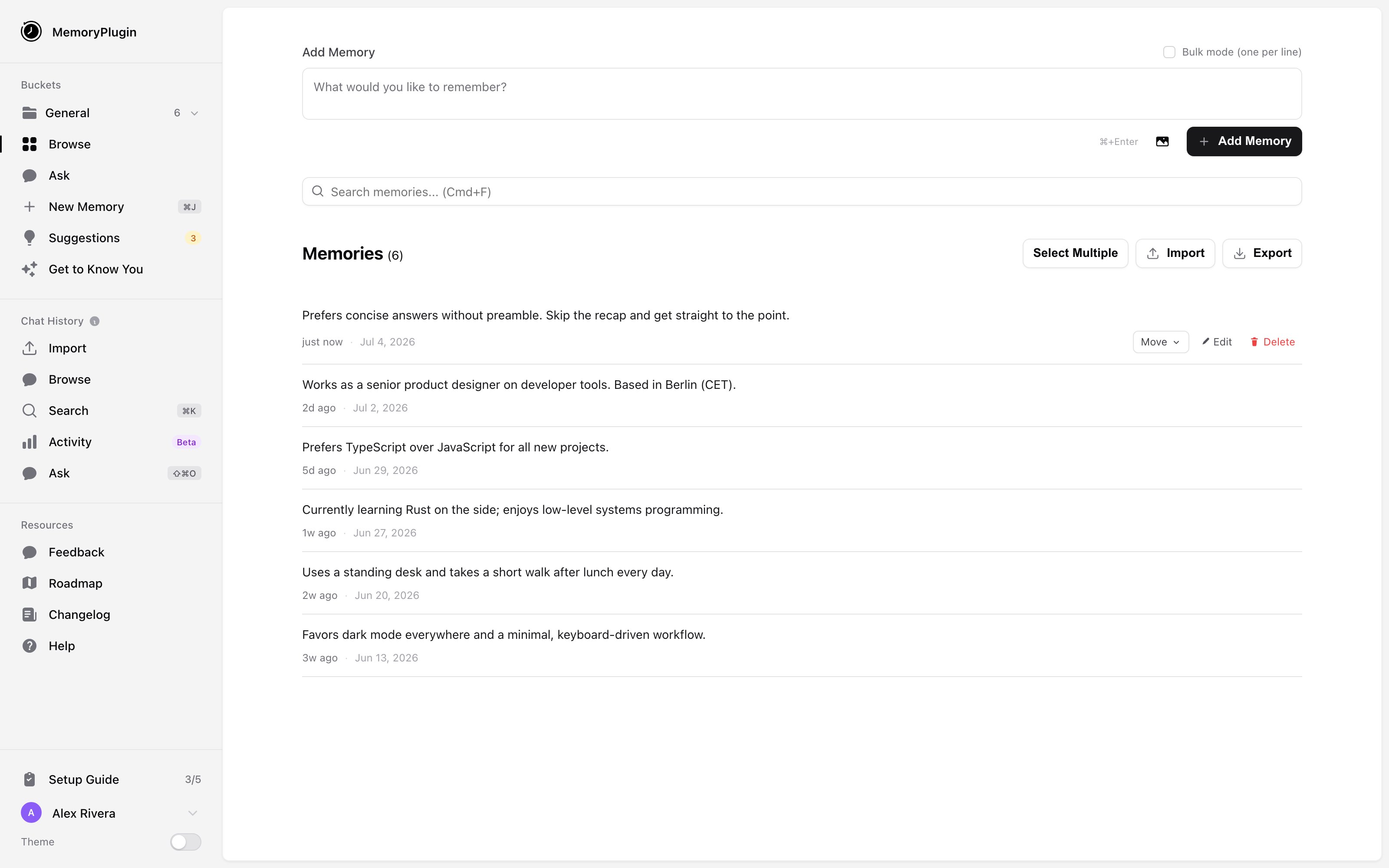
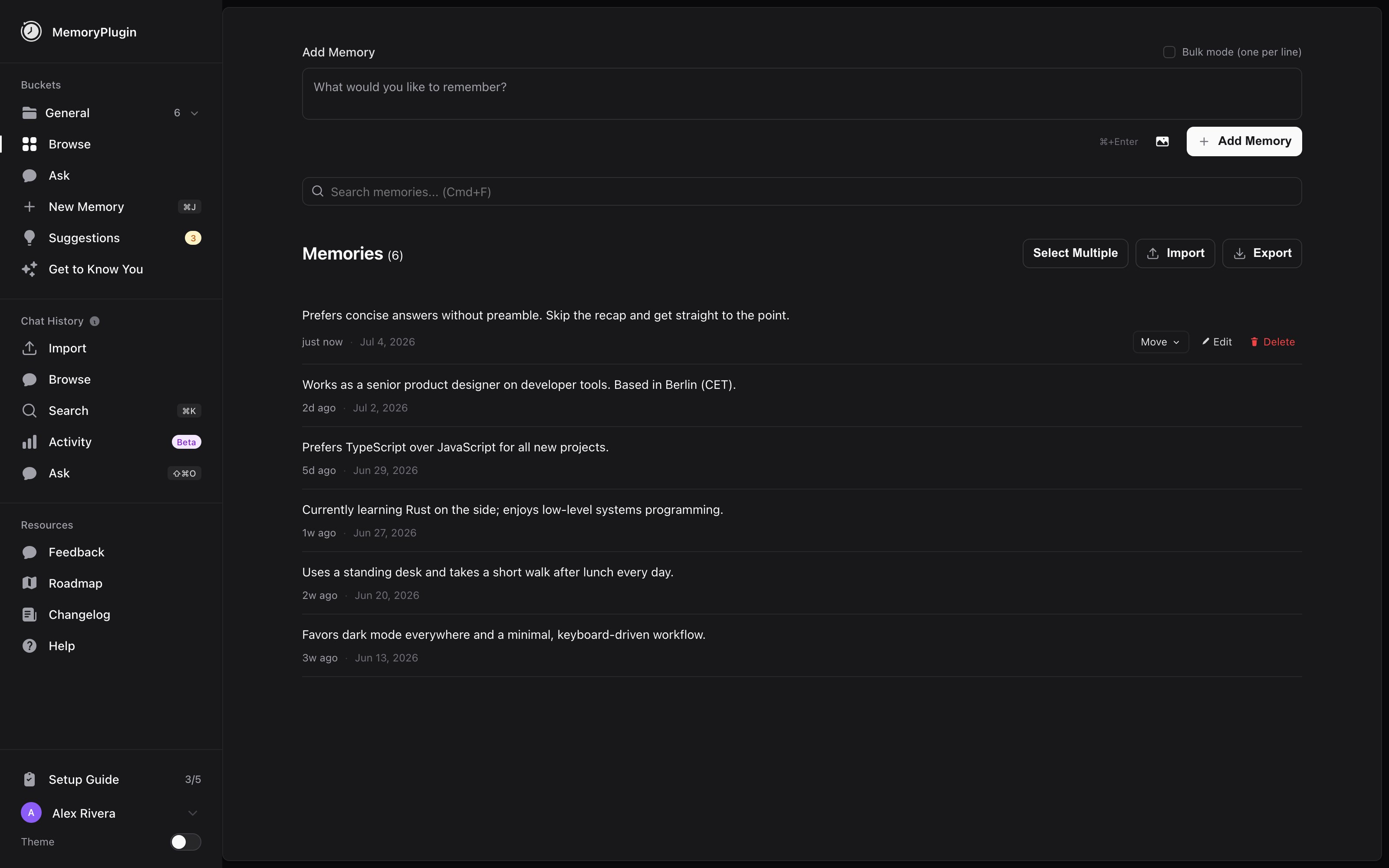
The dashboard: bucket sidebar on the left, the add-memory box and memory list on the right.
Layout
The dashboard uses a fixed left sidebar plus a main content area. The sidebar stays put while you work; the main area shows whichever bucket or feature you have open. A vertical Ask Docs tab sits on the right edge of the screen and opens the docs help panel.Sidebar
The sidebar starts with the two things you do across everything, then lists your libraries, then Connect and Resources.New Memory and Ask
These two sit at the top because they work across memories, files, and chats rather than inside one of them.- New Memory opens the add-memory dialog. Badge: ⌘J. The dialog has its own bucket picker, so it works whichever bucket you are viewing.
- Ask opens the AI query tool. Badge: ⇧⌘O.
Memories
- Bucket selector at the top. Click it to switch buckets or create a new one. Hold ⌘ (or Ctrl) and it shows a ⌘B badge.
- Browse shows the memories in the selected bucket.
- Knowledge Graph (early beta) builds a concept map of a bucket. This item carries a Pro badge and only shows on Pro and higher plans.
Chats
A single Chats item opens your chat-history library. Badge: ⌘K. Browsing, search, and activity stats are view tabs on that page rather than separate sidebar entries.Connect
Connect is where you hook MemoryPlugin up to your AI tools, and where your Authentication Token lives. See Connect below.Resources
Feedback and Roadmap open embedded boards. Changelog and Help open the help center in a new tab.Footer
The sidebar footer holds the Setup Guide button (with a{completed}/{total} step counter, see below), your account button, and a Theme row with the dark mode toggle.
Setup Guide
The Setup Guide is a short onboarding checklist. The footer button shows how many steps you have finished as a{completed}/{total} counter, and clicking it reopens the checklist. It is separate from Get to Know You, which is a conversation that creates memories rather than a checklist.
Keyboard shortcuts
Badges for these appear in the sidebar while you hold the modifier key.
Inside the add and edit forms, ⌘↵ (Ctrl+Enter) saves. ⌘F focuses the memory search box.
Account menu
Click your account button in the sidebar footer to open the account menu. It shows your email, your current plan, and three actions: Settings, Manage Subscription, and Logout.Connect
Connect in the sidebar is the one place for hooking your AI tools up to your memory. Open it at memoryplugin.com/dashboard/connect. It has three tabs.- Tools
- Chat history
- Access
Every tool you have connected, one card each, plus Add a tool to connect a new one. Disconnect a tool from its card; that revokes all of its sessions, including re-authorizations and other devices.
Settings
Settings open as a modal, not a separate page, so you keep your place in the dashboard. Open it from the account menu. It has three tabs.- Profile
- Account
- Notifications
Upload or change your avatar (JPEG, PNG, or WebP, up to 2MB), or fall back to your Google profile picture. Set a Display name shown across the app. Your email is read-only and managed through your Google account.
Settings used to carry Integrations and Connected Apps tabs. Both moved to Connect: your auth token is on the Access tab, and connected tools are on the Tools tab.
Working with memories
The main area is where you add, edit, move, and organize memories.- Add: type into the inline box on the home page, or press ⌘J for the dialog. Turn on bulk mode to add one memory per line. Or click the microphone button next to the inline box and just talk: speak for up to five minutes, and MemoryPlugin transcribes the recording, splits it into clean individual memories, and lets you review each one before anything is saved.
- Search: use the search box (placeholder “Search memories… (Cmd+F)”) to filter the current bucket.
- Edit: each memory has an inline edit action. Memories you have edited show a version pill so you can view the edit history.


Edits never overwrite: each change adds a version, and only the latest one is served.
- Move: send a memory to another bucket from its row.
- Filter: once a bucket has Smart Categories, filter the list by category.
Organizing with buckets
Create buckets to keep contexts separate, for example work apart from personal. Open the bucket selector to switch buckets, create a new memory or file bucket, rename, share, reorder, or delete. Your bucket order is kept in sync between the dashboard and the browser extension. See Memory Buckets. For buckets with 30 or more memories, Smart Memory groups them into categories with summaries so your AI can load only what is relevant. See Smart Memory.Core features
Memory Buckets
Organize memories into separate, isolated contexts
Chat History
Import and search your AI conversations from ChatGPT, Claude, Gemini, Grok, DeepSeek, and TypingMind
Ask
Query your memories, chat history, and files with AI
File Buckets
Upload and query PDFs, Word docs, and text files
Smart Memory
Group large buckets into categories for efficient recall
Suggestions
Clean up duplicates and combine related memories
Other tools in the dashboard
- Suggestions: when a bucket has enough memories, MemoryPlugin can suggest removing duplicates, combining related memories, or updating an outdated one. You review each suggestion and accept or reject it. Open it at memoryplugin.com/dashboard/suggestions.
- Knowledge Graph (early beta): builds a map of how concepts in a bucket connect. Pro and higher plans only; the sidebar entry is hidden on other plans.
- Get to Know You: a short AI interview that creates memories from your answers, useful for filling an empty account quickly. Open it at memoryplugin.com/dashboard/get-started.
- Roadmap & Feedback: embedded boards for seeing what is planned and sharing ideas.
Next steps
Ask Tool
Query your memories, history, and files
Memory Buckets
Organize memories into contexts